db9 right angle female connector 3d drawing
Tech Stuff - RS-232 Cables, Wiring and Pinouts
Brief tutorial and pinouts for RS-232, RS422/485, T1/E1 and V.35. If you want to know more about RS 232 signals then this page may assist - but you lot may also need to lie downwardly in a darkened room afterwards.
Contents
- DTE (PC) and DCE (Modem)
- DB9 and DB25 Male and Female Pin Numbering
- RS232 on DB25 Pinout (RS-232C)
- RS232 on DB9 Pinout (TIA - 574)
- RS232 on RJ45 (RS-232D TIA-561)
- RS232 DB25 Zip Modem Pinout
- RS232 DB9 NULL Modem Pinout
- RS232 DB9 and DB25 Loopback Pinout
- RS232 DB9 Cipher Modem Pinout using Cat5(e)
- RS232 DB9 to DB25 Pinout
- RS232 DB9 to DB25 Zilch Modem Pinout
- RS-422, 423 and 485 TIA/RS-530-A using DB25)
- RS-422 and 485 using DB9
- V.35 on a DB25
- DBx - Designations for D type sub-miniature connectors
- T1/E1 Pinout (RJ-48C)
RS-232 standards(TIA-232) are defined by TIA (Telecommunication Industry Association). RS-232 defines both the physical and electric characteristics of the interface. RS-232 is practically identical to ITU Five.24 (signal clarification and names) and V.28 (electric). RS232 transmit (TX and Receive (RX) are ACTIVE Low voltage interfaces and operates at +12V to -12V where:
- Signal = 0 > +3.0V (Space)
- Signal = i < -3.0V (Mark)
Notes:
-
Indicate voltages in the range >-3.0V to +3.0V are regarded equally being in the 'expressionless area' (indeterminate value) and allow for absorption of noise. For more on the use of signals and other heavy stuff.
-
Control Signals (CTS, RTS, DTR, DSR etc. are Active Loftier (range +3V tp +12V). For more on the use of signals and other heavy stuff.
-
The power level on RS232 pins is defined by TIA for short circuit protection to exist 100mA. Most RS232 drivers will provide lower short circuit protection (peculiarly for laptops). A max of 50mA PER Pivot may be available only the data canvas for the specific interface/chip should be consulted before commiting to externally powered designs.
-
We received an email recently pointing out some bug with Cipher modem cables. The pinouts shown below will generally work. All the same, there are many permutations of signal sets that tin can be used past either stop of a connection and they may not exist SYMMETRIC. Ane end may expect something (a betoken) that the other end cannot generate. This typically happens with CTS/RTS (and perhaps DCD) and DTR/DSR. If you suspect this is the instance then unfortunately y'all need to empathize the interface and may have to 'spoof' (artifically create) sure signals. Our signal primer page may help you. Finally, if you are having serious problems, splash out on what is ofttimes called a 'light box' or some other device that will prove you which signals are being activated.
-
Serial communications equipment may be either a DTE (Data Terminal Equipment - a last or PC) or a DCE (Data Communications Equipment - for example, a modem) and have a direction depending on the type. All the diagrams below define the interface from the DTE perspective.
-
The terms Information Carrier Detect (DCD) and Received Line Signal Detect (RLSD) are 1 and the same. Nosotros use DCD throughout 'cos we think it's more common.
-
While the term RS232 is near universally used these days for serial/modem connections, exterior of North America it is quite mutual to run into the ITU designations V.24/5.28 when describing serial/modem communications. For all applied purposes RS232 and V.24/V.28 are identical.
-
Like nigh folks we use the term DB9 which is widely - merely erroneously - coined to describe a nine-pin serial connector. Nosotros got an email pointing out the error of our ways (hint: information technology is really a DE-9P). So, if you desire to amaze your friends over the dinner table, you can read more than and use the technically correct terms in the future. While we become away with DB9 most of the fourth dimension (with mutual or garden PCs), sometimes it is essential to know EXACTLY what connector blazon you are talking almost. And, following a recent email request, nosotros discovered that the thread on RS-232 (DB9 and 25) receptacles is UNC 4-40.
-
RS-232-East is unremarkably defined to be used with a DB25 connector, but does have a 26 pin (a much smaller) alternative . We suggest that if you come up across 1 of these that y'all do the decent matter - use an curse. Alternatively, with your luck, you could consider buying a lottery ticket.
-
We have received a number of emails asking how to wire DB9's using cat5(due east)/cat 6 cable. We approximate there is a lot of LAN cablevision lying around these days (and its cheap) so folks naturally desire to employ information technology. We have added a naught modem only section to cover this wiring. In that location is absolutely no standard to embrace this grade of wiring. This department is only offered as one of many possible ways to do it. While nosotros are on the topic of wiring, RS232 does not define a cable standard but this may assistance in choosing a suitable cable.
-
We got an electronic mail request about TTY 20ma current loop interfaces. This was an old method used to connect teletype devices and uses current (normally 20ma only sometimes 60ma) to point mark and space. A TTY organisation CANNOT exist connected to RS-232 (which is a voltage driven interface) and has no standard. You will need to go the manufacturer's specifications and start reading!
-
RS-232 is probably the most widely known serial standard because of its utilize in PCs. Information technology uses unbalanced communications (single TX/RX/CTS/RTS connectors) and hence has both speed limitations and is susceptible to noise interference. RS-422 or RS-485 are increasingly common because they utilise balanced advice (2 connectors for most signals) and provide higher speeds (up to 10 mbit/s) and are significantly more robust in electrically noisy environments - such equally automotive, military, telecommunication and marine.
-
Like most people we keep to use the term RS, as in RS-232, RS-422, etc. Many moons ago the standardization effort was taken over past Environmental impact assessment/TIA (sometimes written as TIA/EIA). Now the EIA no longer exists (every bit of February 11th, 2011) and TIA is the merely homo left standing. Consequently, yous volition occasionally encounter references to TIA-232 or TIA-574 etc. Anything with a TIA designation is functionally identical to the same number with an RS designation, thus, TIA-232 = RS-232. Nosotros volition keep to employ the RS term simply because we call up it is all the same more widely used and because old canis familiaris, new tricks.....
DTE (PC) and DCE (Modem)
In serial communications the terminal end (PC) is called the Data Terminal Equipment (DTE) and the modem end is chosen the Information Communications Equipment (DCE) as shown in the diagram below.
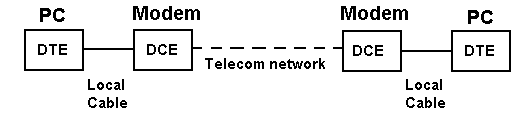
Serial Communications with a modem
RS-232 signals have a direction (in or out) depending on whether they are with respect to a DTE or a DCE. In all the pinout diagrams below the betoken management is with respect to the DTE (PC) end.
NULL Modem Connections
When PCs are connected dorsum-to-back each end is acting as a DTE (there is no DCE in this case) and consequently certain signals may have to be looped in the connection to satisfy whatsoever input bespeak requirement. This is called a Cypher (no) modem configuration. For example, when the DTE raises Request to Send (RTS) it typically expects Clear to Send (CTS) from the DCE. Since there is no DCE to raise CTS, the outgoing RTS betoken is looped in the Nix modem cable to the incoming CTS to satisfy the DTE's demand for this signal. This is shown in the diagram below.
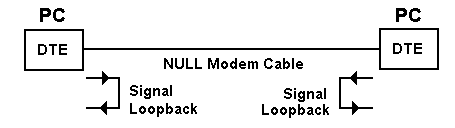
Serial Communications with a Cipher modem configuration

DB9 and DB25 Male and Female Pin Numbering
These diagrams show the male (gray background) and female (black groundwork) pin numbering for DB9 and DB25 sub-miniature connectors. Generally Pin 1 is marked on the front of the connector correct next to the pin - though you may need a magnifying glass to read it. Some manufacturers marking each pivot number on the plastic housing at the rear of the connector. The male connector has the pins sticking out!
DB25 Male and Female
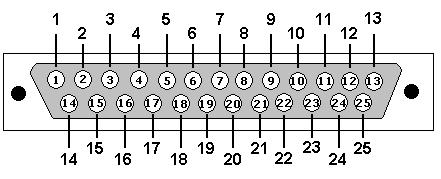
DB25: View looking into male connector
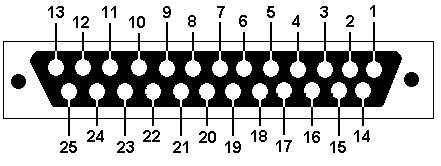
DB25: View looking into female connector
DB9 Male and Female person
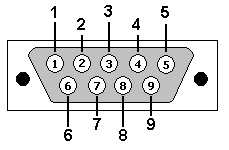
DB9: View looking into male connector
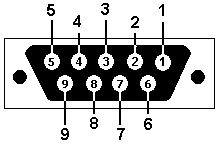
DB9: View looking into female connector
RS232 on DB25 (RS-232C)
The use of each pin including methods for spoofing signals is described in our Point/pin primer. The RS-232 DB25 connector is capable of supporting 2 separate connections - each with its own optional clock when used in Synchronous mode or Flake-Synchronous fashion. If you are using the interface purely for Asynchronous communications then you just need those marked with (ASYNC) below or you tin can apply even fewer (if you sympathise what is happening). The cavalcade marked Dir shows the point direction with respect to the DTE.
Note: This is NOT the same as the DB25 Parallel port on a PC.
| Pin No. | Name | Dir | Notes/Description |
| one | - | - | Protective/shielded ground |
| 2 | TD | OUT | Transmit Data (a.g.a TxD, Tx) (ASYNC) |
| iii | RD | IN | Receive Data (a.grand.a RxD, Rx) (ASYNC) |
| 4 | RTS | OUT | Request To Send (ASYNC) |
| v | CTS | IN | Clear To Send (ASYNC) |
| 6 | DSR | IN | Data Set Ready (ASYNC) |
| 7 | SGND | - | Signal Basis |
| 8 | CD | IN | Carrier Notice (a.one thousand.a DCD). |
| 9 | - | - | Reserved for information prepare testing. |
| 10 | - | - | Reserved for data set testing. |
| 11 | - | - | Unassigned |
| 12 | SDCD | IN | Secondary Carrier Find. Merely needed if second aqueduct beingness used. |
| 13 | SCTS | IN | Secondary Clear to send. Only needed if second channel existence used. |
| fourteen | STD | OUT | Secondary Transmit Data. Merely needed if 2nd channel existence used. |
| fifteen | DB | OUT | Transmit Clock (a.k.a TCLK, TxCLK). Synchronous use merely. |
| 16 | SRD | IN | Secondary Receive Data. But needed if second channel beingness used. |
| 17 | DD | IN | Receive Clock (a.k.a. RCLK). Synchronous use only. |
| 18 | LL | - | Local Loopback |
| 19 | SRTS | OUT | Secondary Request to Send. Only needed if 2d channel being used. |
| 20 | DTR | OUT | Data Last Ready. (ASYNC) |
| 21 | RL/SQ | - | Signal Quality Detector/Remote loopback |
| 22 | RI | IN | Ring Indicator. DCE (Modem) raises when incoming call detected used for auto respond applications. |
| 23 | CH/CI | OUT | Betoken Rate selector. |
| 24 | DA | - | Auxiliary Clock (a.k.a. ACLK). Secondary Channel but. |
| 25 | - | - | Unassigned |
Note: Leave all pins not specified above unconnected.
view - looking into male person connector
(male and female connector diagrams)
RS232 on DB9 (Environmental impact assessment/TIA 574)
Betoken functions are described in detail in our Signal/pivot primer. The cavalcade marked Dir shows the bespeak management with respect to the DTE.
| Pin No. | Name | Dir | Notes/Description |
| 1 | DCD | IN | Data Carrier Notice. Raised past DCE when modem synchronized. |
| 2 | RD | IN | Receive Data (a.k.a RxD, Rx). Arriving information from DCE. |
| 3 | TD | OUT | Transmit Information (a.chiliad.a TxD, Tx). Sending data from DTE. |
| iv | DTR | OUT | Data Final Ready. Raised by DTE when powered on. In auto-answer mode raised only when RI arrives from DCE. |
| five | SGND | - | Footing |
| vi | DSR | IN | Information Gear up Ready. Raised past DCE to betoken set. |
| seven | RTS | OUT | Request To Send. Raised by DTE when information technology wishes to send. Expects CTS from DCE. |
| 8 | CTS | IN | Clear To Send. Raised by DCE in response to RTS from DTE. |
| 9 | RI | IN | Ring Indicator. Set when incoming ring detected - used for machine-answer application. DTE raised DTR to answer. |
DB9 (EIA/TIA 574): View - looking into male connector
(male and female connector diagrams)
RS232 on RJ45 (RS-232D)
More properly EIA/TIA - 561. Use when connecting to or from a serial port with a 8 position Modular Jack (RJ45). If you are cross-connecting from a DB9 or a DB25 utilise the indicate names to cross connect the advisable pins. To illustrate the procedure the equivalent pins used for cross-connecting a DB9 connector signals are shown (see DB9 pivot-out above).
Betoken/pin primer
| RJ45 Pin No. | Name | DB9 Cross Connect | Notes/Clarification |
| ane | DSR/RI | 6,ix | Information set Ready/ring indicator |
| ii | DCD | 1 | Information Carrier Detect |
| three | DTR | iv | Data Terminal Ready |
| 4 | SGND | 5 | Bespeak Footing |
| v | RD | 2 | Receive Data |
| 6 | TD | 3 | Transmit Data |
| vii | CTS | viii | Clear to Send |
| 8 | RTS | 7 | Request to Transport |
Note: Pin 1 is a multi-function pin sharing DSR (Data Ready Ready) and RI (Ring Indicator). This means it is impossible to differentiate betwixt a incoming ring signal (RI) and when the modem has finally connected and synched up (DSR). With local (nothing modem connections) or if the modem is run in auto-answer fashion this is not normally a problem. If used with a modem and the DTE (the figurer stop) wants to command the connectedness the problem is more real. DSR would usually signal the 'connected and synched-up' country following DTR from the DTE whereas RI just indicates a ring voltage is nowadays on the line and would usually be the trigger for the DTE to raise DTR if it wants to accept the call. DCD volition bespeak that a carrier has been received but does not indicate synchronization of both ends. In near cases notwithstanding CTS (Articulate To Send) in response to RTS (Request To Send) volition non usually exist returned until an end-to-end connection is available (equivalent to the DSR country).
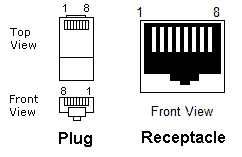
RJ45 Male Connector Pin Numbering
RS232 DB25 NULL Modem Pinout
Utilise when connecting two systems (due east.g. PCs) via their DB25 interfaces without a modem (i.eastward. back-to-back). See the full signal names in the DB25 sections.
If this pinout does non work for you lot and then yous could endeavour our Signal/pin primer because you may need to SPOOF connections.
Note: This DB25 is NOT the same as the DB25 Parallel port on a PC which is defined here.
| DB25 | Indicate | DB25 | Betoken |
| 3 | RD | ii | TD |
| 2 | TD | three | RD |
| 20 | DTR | 6,viii | DSR, DCD |
| half dozen,8 | DSR, DCD | 20 | DTR |
| iv | RTS | 5 | CTS |
| 5 | CTS | 4 | RTS |
| seven | SGND | 7 | SGND |
| 22 | RI | 22 | RI |
DB25: View - looking into male connector
(male and female connector diagrams)
NOTE:
-
Leave all pins not specified above unconnected.
-
Nosotros have received e-mail suggesting that the higher up pinout looks like DTR from one side is driving into DSR/DCD on the other side - non normally a healthy situation. The emails miss the point that since this is a Zippo modem connexion both ends are DTEs. The 2 peer DTE'south treat DSR/DCD signals as RX (INPUT) merely. The INPUT DSR/DCD on one side is created past cross connecting the OUTPUT DTR indicate for the other peer.
RS232 DB9 Zip Modem Pinout
Apply when connecting 2 systems, for case 2 PCs, via their DB9 interfaces without a modem. Typically called a back-to-back or NULL modem connectedness. See the full signal names in the DB9 section.
If this pinout does non work for y'all then you could try our Signal/pin primer because you may need to SPOOF connections.
| PC1 Peer | PC2 Peer | ||
| DB9 Pin | Signal | DB9 Pivot | Signal |
| two | RD | 3 | TD |
| iii | TD | 2 | RD |
| 4 | DTR | 6,1 | DSR, DCD |
| 6,ane | DSR, DCD | 4 | DTR |
| 7 | RTS | 8 | CTS |
| eight | CTS | 7 | RTS |
| 5 | SGND | 5 | SGND |
| 9 | RI | 9 | RI |
DB9 TIA/Environmental impact assessment 574: View - looking into male connector
(male person and female connector diagrams)
Notation:
-
We accept received e-mail suggesting that the above pinout looks like DTR from one side is driving into DSR/DCD on the other side - not normally a healthy situation. The emails miss the indicate that since this is a Naught modem connection both ends are DTEs. The two peer DTE'due south treat DSR/DCD signals as RX (INPUT) just. The INPUT DSR/DCD on 1 side is created past cross connecting the OUTPUT DTR signal for the other peer.
RS232 DB9 and DB25 Loopback Pinout
Loopback is a method of testing the RS232 connector and interface circuitry to ensure it is functioning correctly, that is, in layman'south jargon - information technology own't bankrupt! If communication fails to occur between ii machines the question that immediately arises is - which finish is broken? In the worst case both ends could even be broken in which case ritual suicide may be the all-time solution. Loopback works by testing each end of the connection independently. Data is sent and received on the same RS232 connector - which may be either DB9 or DB25. The test commonly consists of using some programme to transmit data. The programme then checks to ensure exactly the same data was received. Loopback testing gives y'all a binary result - information technology works, in which instance the end under test is good, or information technology does not, in which instance the end under exam is broken. Pinouts are shown for both DB9 and DB25. The loopback is commonly constructed in the DB shell or using a diagnostic light-box.
DB9 Loopback
| DB9 | Signal | Loopback to | Indicate |
| two | RD | 3 | TD |
| iii | TD | ii | RD |
| 4 | DTR | 6,1,9 | DSR, DCD, RI |
| 7 | RTS | eight | CTS |
| 5 | SGND | v | SGND |
(DB9 male person and female connector diagrams)
NOTE:
-
Nosotros show 4 (DTR) being looped to half dozen (DSR), 1 (DCD) and 9 (RI). RI (9) is included because we understand that certain test programs employ this to ensure a more than complete test of the interface indicate set.
DB25 Loopack
| DB25 | Signal | Loopback to | Signal |
| 3 | RD | 2 | TD |
| two | TD | 3 | RD |
| 4 | RTS | 5 | CTS |
| 5 | CTS | four | RTS |
| 7 | SGND | 7 | SGND |
| 15 | DB | 17 | DD |
| 20 | DTR | 6,viii,22 | DSR, DCD, RI |
| 23 | CH/CI | 23 | CH/CI |
(male and female person connector diagrams)
Annotation:
-
For the sake of simplicity this loopback volition only work for the master channel. Full DB25 interfaces allow a secondary channel. If a complete interface loopback is required y'all will demand to add together pins 12, 13, 14, 16, nineteen, 24.
-
Past looping the primary channel clocks (15 and 17) both synchronous and asynchronous capabilities can exist tested. If merely asynchronous tests are being performed omit this, and the pin 23 loopback
-
Nosotros show 20 (DTR) existence looped to 6 (DSR), 8 (DCD) and 22 (RI). RI (22) is included because we understand that certain test programs use this to ensure a more than consummate examination of the interface signal set.
RS232 DB9 Zip Modem Pinout on CAT5/CAT5(e)/CAT6
This is in response to a number of contempo emails request how to wire both ends of a DB9 connection using cat5, cat5(e) or cat6 cable. This must non exist dislocated with DB9 to RJ45 (RS232D). Nosotros take shown a null modem (back-to-dorsum PCs) only configuration. And if you lot want to use cat5, cat5(e) or true cat vi with a existent modem (a DB25 connector)? Our advice - don't.
Alarm:. At that place is, equally far equally we know, no standard to embrace the use of cat5, cat5(due east) or true cat half dozen (8 conductor) wiring when used with ii DB9 connectors. Any such wiring scheme is therefore non-standard - that includes the wiring scheme below. Specifically this means that both ends of the cable must be wired in the same way and that no assumptions can be made about how the other end is wired. You lot will have to manually inspect both ends of the connectedness. Damage can effect from mis-matched wiring.
A DB9 clearly has nine connections and a cat5, cat5(e) and cat 6 cable has eight conductors. RS232D has chosen to use Pin 1 as a multi-office pin (DSR/RI) to provide maximum flexibility with modems - in detail it allows for DCD which is a meaningful signal from a modem but not, we suggest, from a peer PC. Nosotros have called to use a pocket-sized variation on the normal DB9 Null modem pinout above - specifically we take allowed for RI which could exist used from a peer PC to commence a manual sequence. The colors used are unimportant but the suggested configuration is ane style to provide the shortest use of the adjacent (twisted) pairs.
If this pinout does not work for you and then you could effort our Bespeak/pivot primer because yous may need to SPOOF connections.
| PC1 Peer | PC2 Peer | ||||
| DB9 | Signal | cat5(eastward) Color | DB9 | Signal | cat5(e) Color |
| 2 | RD | Brown | 3 | TD | Blue |
| 3 | TD | Blue | two | RD | Brown |
| 4 | DTR | Green | 6,i | DSR, DCD | Chocolate-brown-white |
| 6,one | DSR, DCD | Brown-white | 4 | DTR | Green |
| seven | RTS | Blue-white | 8 | CTS | Green-white |
| viii | CTS | Light-green-white | 7 | RTS | Blueish-white |
| v | SGND | Orangish | v | SGND | Orange |
| 9 | RI | Orange-white | 9 | RI | Orange-white |
DB9: View - looking into male person connector
(male person and female connector diagrams)
NOTE:
-
We accept received email suggesting that the above pinout looks like DTR from one side is driving into DSR/DCD on the other side - non normally a salubrious situation. The emails miss the signal that since this is a Aught modem connection both ends are DTEs. The two peer DTE'southward treat DSR/DCD signals as RX (INPUT) only. The INPUT DSR/DCD on i side is created past cross connecting the OUTPUT DTR signal for the other peer.
RS232 DB9 to DB25 Pinout
Apply when connecting a DB9 (eastward.g. a PC) to a DB25 (e.thousand. a modem) interface. Run into the full betoken names in the DB9 and DB25 section.
Indicate/pivot primer
| DB9 | Bespeak | DB25 |
| 1 | DCD | 8 |
| 2 | RD | three |
| 3 | TD | 2 |
| four | DTR | xx |
| v | SGND | seven |
| 6 | DSR | 6 |
| 7 | RTS | four |
| eight | CTS | 5 |
| 9 | RI | 22 |
View - looking into male connector
(male and female person connector diagrams)
View - looking into male connector
(male person and female connector diagrams)
Note: Leave all pins not specified higher up unconnected.
RS232 DB9 to DB25 Aught Modem Pinout
Use when connecting two systems (east.g. PCs) when one has a DB9 interface and the other a DB25 interface without a modem. Typically called a back-to-back or NULL modem connection. Encounter the full signal names in the DB9 and DB25 sections.
Betoken/pivot primer
| DB9 | Point | DB25 | Signal |
| ii | RD | two | TD |
| 3 | TD | three | RD |
| iv | DTR | 6,8 | DSR, DCD |
| 6,1 | DSR, DCD | xx | DTR |
| 7 | RTS | 5 | CTS |
| 8 | CTS | four | RTS |
| 5 | SGND | 7 | SGND |
| 9 | RI | 22 | RI |
DB9: View - looking into male connector
(male person and female connector diagrams)
View - looking into male connector
(male person and female connector diagrams)
Note: Leave all pins not specified above unconnected.
RS-422, RS423 and RS-485 (TIA/RS-530-A using DB25)
RS 530-A defines the pinout when using either balanced RS-422 (and RS-485) or unbalanced RS-423 using a DB25 connector. The A (+) and B (-) below refer to each indicate pair used in balanced serial interfaces (A+ is not-inverting, B- is inverting). When used with RS-423 (unbalanced) the B (-) are tied to a common footing. Signals marked U under Bal/Ubal are non counterbalanced since they typically change very infrequently (for instance one time per session) and therefore do non bear upon TX/RX performance sensitivity - hence speed. BEWARE: RS-530 (without the A suffix) is an earlier standard and is wired differently (in item both DTE Prepare/DTR and DCE Ready/DSR used balanced communications - 2 pins). This is the RS-530-A pinout spec in which DTE Prepare/DTR, DCE Ready/DSR are unbalanced and RI is introduced on Pivot 22. The pinout supports both synchronous (V.35/v.ten/5.11) which require clocks and aynchronous systems (RS-422/RS-485) which do non require clocks. The column marked 422/485 indicates the signals required for these interfaces - all others are Due north.C. (Not connected). RS422/485 on a DB9 is separately defined.
RS-422 vs RS-485: Many of us get confused over the difference between RS-422 (multi-drib) and RS-485 (multi-point). RS-422 allows only one principal (or transmitter) all others are only receivers.
Notes:
-
MIL-STD-188-114B reportedly does interwork with RS-422/485.
| Pin No. | RS Bespeak Name | Bal/Ubal | 422/485 | Notes |
| 1 | Shield | Y | Cable Shield, continued at DTE only. | |
| ii | Transmit Data (A+) | Y | a.k.a TxD | |
| 3 | Received Data (A+) | Y | a.k.a. RxD | |
| iv | RTS (A+) | Y | Request To Send | |
| five | CTS (A+) | Y | Clear To Transport | |
| 6 | DCE Gear up (modem/CSU) | U | Y | a.k.a DSR |
| 7 | Signal Ground | Y | - | |
| 8 | Data Carrier Observe (A+) | Y | a.k.a DCD, CD or RLSD | |
| 9 | Receiver Signal Element Timing (B-) | RX Clock | ||
| ten | Data Carrier Detect (B-) | - | Y | a.m.a DCD, CD or RLSD |
| 11 | Ext. Transmit Clock (B-) | - | - | |
| 12 | Transmit Signal Element Timing (B-) | TX CLOCK | ||
| thirteen | CTS (B-) | Y | Clear to Transport | |
| fourteen | Transmit Data (B-) | Y | a.grand.a TxD | |
| 15 | Transmit Signal element Timing (A+) | TX CLOCK | ||
| 16 | Received Data (B-) | Y | a.m.a RxD | |
| 17 | Receiver Signal Chemical element Timing (A+) | RX CLOCK | ||
| 18 | Local Loopback | U | ||
| 19 | RTS (B-) | Y | Asking to Send | |
| twenty | DTE Gear up | U | Y | a.k.a DTR |
| 21 | Remote Loopback | U | - | |
| 22 | Band Indicator | Y | RI | |
| 23 | Signal Ground | Y | - | |
| 24 | Ext TX Clock (A+) | - | ||
| 25 | TM | U | Test Way |
RS-422 and RS-485 (DB9)
At that place is no official standard for using RS-422 or RS-485 on a DB9. The following pinout is widely used by many manufacturers but yous are advised to verify with the manufacturer's specifications before proceeding. The following pinout provides no features for signaling end-to-end equipment readiness (for case DTE Ready/DTR and DCE Prepare/DSR - run into RS422/485 on DB25). Software drivers must use the CTS/RTS signals to point the presence and readiness of the peer.
Notes:
-
The A (+) and B (-) below refer to each bespeak pair used in balanced serial interfaces (A+ is not-inverting, B- is inverting).
| DB9 Pin | Signal | Notes |
| 1 | Ground | |
| two | CTS (A+) | Clear to Send |
| 3 | RTS (A+) | Asking to Ship |
| 4 | Receive Data (A+) | RxD |
| 5 | Receive Data (B-) | RxD |
| vi | CTS (B-) | Clear To Send |
| vii | RTS (B-) | Request to Ship |
| 8 | Transmit Data (A+) | TxD |
| 9 | Transmit Data (B-) | TxD |
V.35 on DB25 (RS-530-A)
The original V.35 specification defined use of balanced signals over a huge 35 pin connector. V.35 has been obsolete for years (replaced with V.ten) though the term is however ofttimes used. Virtually modernistic systems that call themselves 5.35 employ a DB25 connector which has more small-scale dimensions and uses the RS-530-A pinout scheme and maps the Five.35 point names to the RS-530-A names for convenience. The A (+) and B (-) beneath refer to each signal pair used in balanced series interfaces (A+ is non-inverting, B- is inverting). Signals marked U under Bal/Ubal are non balanced since they typically change very infrequently (for example once per session) and therefore do non affect TX/RX performance sensitivity - hence speed. BEWARE: RS-530 (without the A suffix) is an before standard and is wired differently (in item both DTE Ready/DTR and DCE Set/DSR used balanced communications - two pins). This is the RS-530-A pinout spec in which DTE Ready/DTR, DCE Ready/DSR are unbalanced and RI is introduced on Pin 22. The point names used in the pinout below refer to the standard (original) V.35 spec.
Signal/pin primer
| Pin No. | 5.35 Proper noun | Bal/Ubal | Notes/RS Signal Name |
| 1 | Shield | Cablevision Shield, connected at DTE but. | |
| 2 | BA | Transmit Information (A+) (a.1000.a TxD) | |
| three | BB | Received Information (A+) (a.thousand.a. RxD) | |
| 4 | CA/CJ | RTS (A+) Request To Ship | |
| 5 | CB | CTS (A+) Clear To Send | |
| 6 | CC | U | Data Communications Equipment Ready (modem/CSU) (a.k.a DSR) |
| 7 | AB | Signal Basis | |
| 8 | CF | Information Carrier Detect (A+) (a.m.a DCD, CD or RLSD) | |
| 9 | DD | Receiver Bespeak Element Timing (B-) RX Clock | |
| ten | CF | - | Information Carrier Discover (B-) (a.g.a DCD, CD or RLSD) |
| 11 | DA | - | Ext. Transmit Clock (B-) |
| 12 | DB | Transmit Point Chemical element Timing (B-) TX CLOCK | |
| 13 | CB | CTS (B-) Articulate to Send | |
| 14 | BA | Transmit Data (TD) (B-) (a.k.a TxD) | |
| fifteen | DB | Transmit Signal element Timing (A+) TX CLOCK | |
| 16 | BB | Received Data (B-) (a.chiliad.a RxD) | |
| 17 | DD | Receiver Signal Chemical element Timing (A+) RX CLOCK | |
| 18 | LL | U | Local Loopback |
| 19 | CA/CJ | RTS (B-) Asking to Send | |
| twenty | CD | U | DTE Ready (a.k.a DTR) |
| 21 | RL | U | Remote Loopback |
| 22 | RI Ring Indicator | ||
| 23 | Air conditioning | Signal Basis | |
| 24 | DA | Ext TX Clock (A+) | |
| 25 | TM | U | Exam Way |
NOTES:
- Leave any pins not specified to a higher place unconnected.
- In counterbalanced mode signals with the same name are the paired set, for example, pins 2 and 14 are both named BA and form the Transmit Data pair. Each bespeak of the pair is either a loftier (A+) or low (B-)
- When used with RS-485 in one-half-duplex, multi-dropped environments a uncomplicated iii signal arrangements is frequently used - one pin is used as a GND and RX/TX is alternately switched onto a balanced pair of wires which can be either the BA (TX) or BB (RX) pair.
View - looking into male connector
(DB25 male and female connector diagrams)
DB - Designations for D-subminiature Connectors
This lists the designations for DB connectors (supplied by Rob Recny - Thanks). Whatsoever errors in this listing are ours not Rob's.
-
A - xv-pin 2-row joystick connector.
-
B - 25-pin 2-row serial or parallel connector - also 44-pin high-density 3-row.
-
C - 37-pin connector - sometimes found on multi-port serial or data acquisition boards.
-
D - 50-pin connector - a little longer than C, but three rows using the aforementioned pins as the 2-row connectors.
-
East - 9-pin two-row serial - also 3-row VGA.
So a DB9 is more than properly a DE-9P. Isn't noesis a wonderful thing!
The thread size on an RS232 receptacle (the jackscrew) is UNC 4-40.
T1/E1 Pinout (RJ-48C)
T1/E1 wiring may employ either a RJ45, DB15 or BNC connectors. The pinout shown uses RJ45 connectors - its formal proper noun is USOC RJ-48C and is divers in ANSI T1-403-1989. T1 is a North America (primarily) digital service providing i.544 Mbps. E1 is a European/Rest of World standard providing digital service at two.048 Mbps. CATegory v(due east) cabling is used to provide balanced pairs. The color coding for Cat v(e) cabling may be 568A or 568B.
| RJ45 Pin | Signal | Notes |
| one | RX1 (Ring - negative) | |
| 2 | RX2 (TIP - positive) | |
| three | FGND (RX GND) | Ground/Shield |
| iv | TX1 (Ring - negative) | |
| v | TX2 (TIP - positive) | |
| 6 | FGND (TX GND) | Ground/Shield |
| vii | NC | Unused |
| 8 | NC | Unused |
NOTES:
- NC = Not continued.
- There are a confusing number of pinouts for use with an RJ45/48C connector. Some specs show use of pins 7,viii for Grounds. E'er consult any equipment specification if bachelor.
- The telecom earth loves its Tip and Ring designations. Tip is assumed to carry a positive voltage (and would carry the manual signal), Ring a negative voltage (and would carry the inverted transmission signal)
Problems, comments, suggestions, corrections (including cleaved links) or something to add? Please accept the time from a busy life to 'mail us' (at elevation of screen), the webmaster (below) or info-support at zytrax. You volition have a warm inner glow for the residuum of the solar day.
Source: https://www.zytrax.com/tech/layer_1/cables/tech_rs232.htm

Enviar um comentário for "db9 right angle female connector 3d drawing"